Google has recently made the news for offering its 23,000 a 10% raise and a $1000 bonus. Sounds like a great time to work at Google. Unless you're the employee who accidentally leaked the memo making this announcement.
According to the LA Times, Google immediately fired the employee responsible for releasing the info to the press. When asked about the incident, a Google spokesman stated that, "We don't comment on personal matters." To me, this doesn't seem like a great response by a company who one would imagine has a pretty well-staffed and (apparently) well-paid PR department. Moreover, if Google sent out a memo to its 23,000 employees containing this information, the rest of the 'public' was likely to find out at some point anyway. I'm not very familiar with Google's press activity, but this seems a little drastic to me.
Thursday, November 11, 2010

Tuesday, November 9, 2010
Team Coco Prevails!

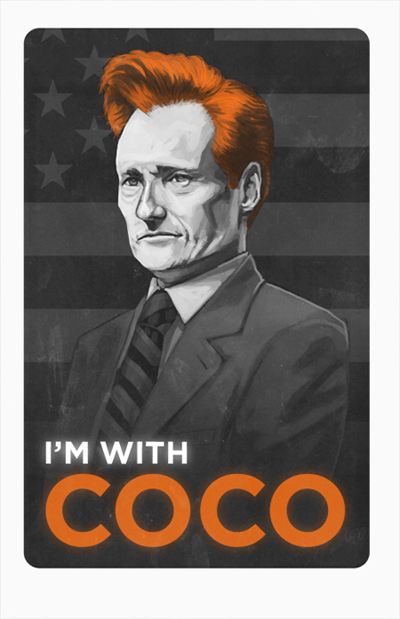
There was a lot of controversy back in January about Conan O'Briens leaving NBC's "The Tonight Show" because Jay Leno wanted his old job back.
Last night "Conan" premiered on TBS capturing an audience of 4.2 million. This show dramatically beat out all other competition. What really interests me is how 3.3 million of "Conan" viewers were in the 18-49 demographic. This is more than 3 times the amount of viewers in this demographic that viewed Jay Leno's "Tonight Show" and 2.5 times the amount of viewers in this demo that viewed David Letterman's "Late Show."
I am curious of how "Conan" attracted so many more viewers out of this demographic. Was it his hilarious promos and his never-ending tweets concerning his show?
Putting Performance Reviews On Probation

I found this article extremely interesting. It has to do with employee reviews that are done at most organizations. These reviews have recently come under controversy because these reviews make it impossible to have open, honest conversations with employers.
This can potentially make for a very unhappy internal public. And shuts down open communication. I just thought this is a very interesting aspect of most employee's relationship with their employer.
Company Accused of Firing Over Facebook Post
What happens to an employee's rights when they work for a private company? Should they give up any right to privacy or free speech rights as part of their employment?
http://www.nytimes.com/2010/11/09/business/09facebook.html?emc=eta1
http://www.nytimes.com/2010/11/09/business/09facebook.html?emc=eta1
Sunday, November 7, 2010
Attack on Domino's
I just wanted to post this as a follow-up to the Domino's group. I saw this billboard today on Colorado (the first shown in this blog posting). With all of the political attack ads that have been around lately, I thought it was interesting to see a pizza company attack ad. Do you think an ad like this will be successful? Should Domino's respond? If so, how?
NPR Case Study
Jen Cupp
Leanna Dillon
Jennifer Davis
Kelly Burt

A. Brief History and Background
In October 2010, NPR fired Juan Williams, a longtime correspondent and political analyst for NPR. The firing came after controversial remarks Williams made on The O'Reilly Factor show on FOX News.
The bulk of the controversy centered around a statement Williams made in response to a polemic question by the show's host, Bill O'Reilly: "But when I get on the plane, I got to tell you, if I see people who are in Muslim garb and I think, you know, they are identifying themselves first and foremost as Muslims, I get worried. I get nervous," Williams said.
Later in the show Williams cautioned Americans to not think of all Muslims as extremists. However, NPR still fired him the following day for his original comment, which garnered strong criticism (both the comment and the firing).
Williams had become a liability to NPR, at least in the view of the station's executives, because of his repeated appearances (and comments) on FOX News, particularly its prime-time talk shows. NPR initially moved him from correspondent to analyst after he took distinct policy positions in comments on FOX News and in editorials for print news. NPR's management was worried about the credibility of Williams and its own reputation as a news source, given his "reporter by day, pundit by night" persona.
Williams's statement on The O'Reilly Factor was the final straw--NPR said these remarks were ultimately inconsistent with its editorial standards and practices, pointing to its code of ethics as reason enough to fire Williams.
NPR at first was fairly quiet about the ordeal, releasing a simple statement (and story) on the day it fired Williams explaining its decision based on its code of ethics. The Internet lit up with comments criticizing Williams and NPR. Some praised the firing; others denounced it. NPR did little to respond to these comments. The NPR ombudsman released a report later that day, concluding that NPR had mishandled the firing, but was justified in doing it.
B. Key Stakeholders
Internal:
* NPR employees
* NPR management, including CEO Vivian Schiller
* Shareholders
External:
* NPR listeners, viewers, and readers
* Government (as NPR was created by congressional passage of the Public Broadcasting Act)
* Related organizations Public Broadcasting Service (PBS) and the Corporation for Public Broadcasting
* Competitors (local and national radio news programs)
* Fox News (acquired Juan Williams after his firing)
* Other media
C. Political, Social/Cultural, and Economic Factors
Political Factors:
The U.S. is deeply divided between liberal and conservative viewpoints. There is an election currently underway which will affect the leadership of the U.S. During election season, everything becomes politicized. NPR has been considered "left leaning" because of firing Juan Williams for expressing his fear about Muslims. Conservatives tend to view the firing as unfair, while many liberals view it as justified.
Social/Cultural Factors:
The firing took place during a time when the ground zero mosque was/is still being debated. "Islamophobia" is becoming a widespread trend, and the question of whether Muslims are to blame for 9/11 is on a lot of people's minds based on the media's agenda. Bill O'Reilly recently blamed Muslims for 9/11 while on "The View." American culture, through the media, is marking Muslims as villains. This isn't necessarily new, but continues to be a current trend. This is an issue that, like being liberal or conservative, divides people.
Economic Factors:
The U.S. is in an economic downturn. This has instilled fear in many people about many issues related to money. There are fears of job security, being able to pay bills, mortgages, rent, etc. Most people have less extra money and this conflict has created a situation where many people will no longer contribute to NPR because of the firing. People want someone to blame. It's easy to blame Muslims for the state the U.S. is in now. If Muslims are to blame for 9/11, then they are also to blame for the situation we are now in economically and for the war in Iraq.
D. Potential Solutions to the Problem
NPR could have approached this problem in the following different ways:
Instead of firing Juan Williams, NPR could have suspended him or waited until his contract ran out. Suspension would have shown that NPR does not agree with Williams's remarks about Muslims while still keeping him as an employee. Suspension may have also suggested that NPR was carefully planning a fair course of action and consequences for Juan Williams.
NPR could have also been more willing to discuss the situation with Williams instead of taking such immediate and severe action. Williams expressed his dissatisfaction with the lack of specificity NPR showed in explaining its decision. In an appearance on FOX News, Williams said he was told his contract was terminated without an opportunity to come into NPR and discuss the termination. It is important for any type of business to address firing an employee with consideration, disclosure, and respect.
Today, NPR can alleviate some PR pressure by giving out a detailed explanation of the circumstances that led to the firing of Juan Williams. Instead of only mentioning its ethics code, NPR could point out and state certain sections that it feels Williams violated, while reiterating to the public NPR's commitment to ethically sound journalism.
Questions:
1. In what ways was it appropriate and inappropriate for NPR to base the firing of Juan Williams on a violation of their ethics code without giving him a specific explanation of how his remarks crossed the line?
2. Do you think that NPR will lose a significant amount of funding because of either Williams's comment or because of how they handled the situation? Has your own perception of NPR changed?
3. In a recent interview with FOX News, where Williams is now a full time contributor, Williams offered a rebuttal to NPR's decision by saying: "And now they have used an honest statement of feeling as basis for a charge of bigotry to create a basis for firing me. Well, now that I no longer work for NPR let me give you my opinion. This is an outrageous violation of journalistic standards and ethics by management that has no use for a diversity of opinion, ideas or a diversity of staff (I was the only black male on the air). This is evidence of one-party rule and one sided thinking at NPR that leads to enforced ideology, speech and writing. It leads to people, especially journalists, being sent to the gulag for raising the wrong questions and displaying independence of thought." Do you agree with Williams? Is NPR hypocritical to fire Williams based on ethics, when he asserts that their own decision was unethical? What does his firing say, if anything, about the media and freedom of speech?
4. What kind of strategy do you think it is, if any, for FOX News to hire Juan Williams full time after the comments he made on its program, The O'Reilly Factor, and his subsequent firing from NPR?
Friday, November 5, 2010
MSNBC suspends Keith Olberman...
http://news.yahoo.com/s/yblog_upshot/20101105/bs_yblog_upshot/msnbc-suspends-olbermann-over-political-contributions
There's been a lot of controversy over how MSNBC covered the elections. It turns out that Keith Olberman donated to several liberal candidates and didn't disclose this before going on air to cover the election. He has been suspended indefinitely without pay...
There seems to be a lot of this coming out lately... Do you think it's fair to suspend him even though he (and many others on the show) are obviously liberal themselves? Does it make a difference to a viewer if he makes monetary contributions?
Is this going to affect viewership of MSNBC?
There's been a lot of controversy over how MSNBC covered the elections. It turns out that Keith Olberman donated to several liberal candidates and didn't disclose this before going on air to cover the election. He has been suspended indefinitely without pay...
There seems to be a lot of this coming out lately... Do you think it's fair to suspend him even though he (and many others on the show) are obviously liberal themselves? Does it make a difference to a viewer if he makes monetary contributions?
Is this going to affect viewership of MSNBC?
Subscribe to:
Posts (Atom)